

 info@cultbooking.com
  0049 30 726225 0
Published on: 10 Jul 2026
Lukas, a Munich-based architect, is in love with the mountains. He stands on his balcony in Schwabing, looking at the distant, hazy outline of the Alps. It’s mid-June, and he is raring to take a weekend escape with his Golden Retriever, Bruno.
Recently, he has been using ChatGPT a lot, especially for AI hotel search, ever since it proved to be a seasoned AI travel assistant on his last fun trip to Berlin.
He doesn’t have to go through the flashing “only 2 rooms left!” banners or the loud image carousels. The AI system reliably does the job for him whenever he needs it.
Here’s a snapshot from his conversation which shows how search is changing. He didn’t search for “best mountain hotels in Garmisch.” Instead, he provided a specific, complex intent.
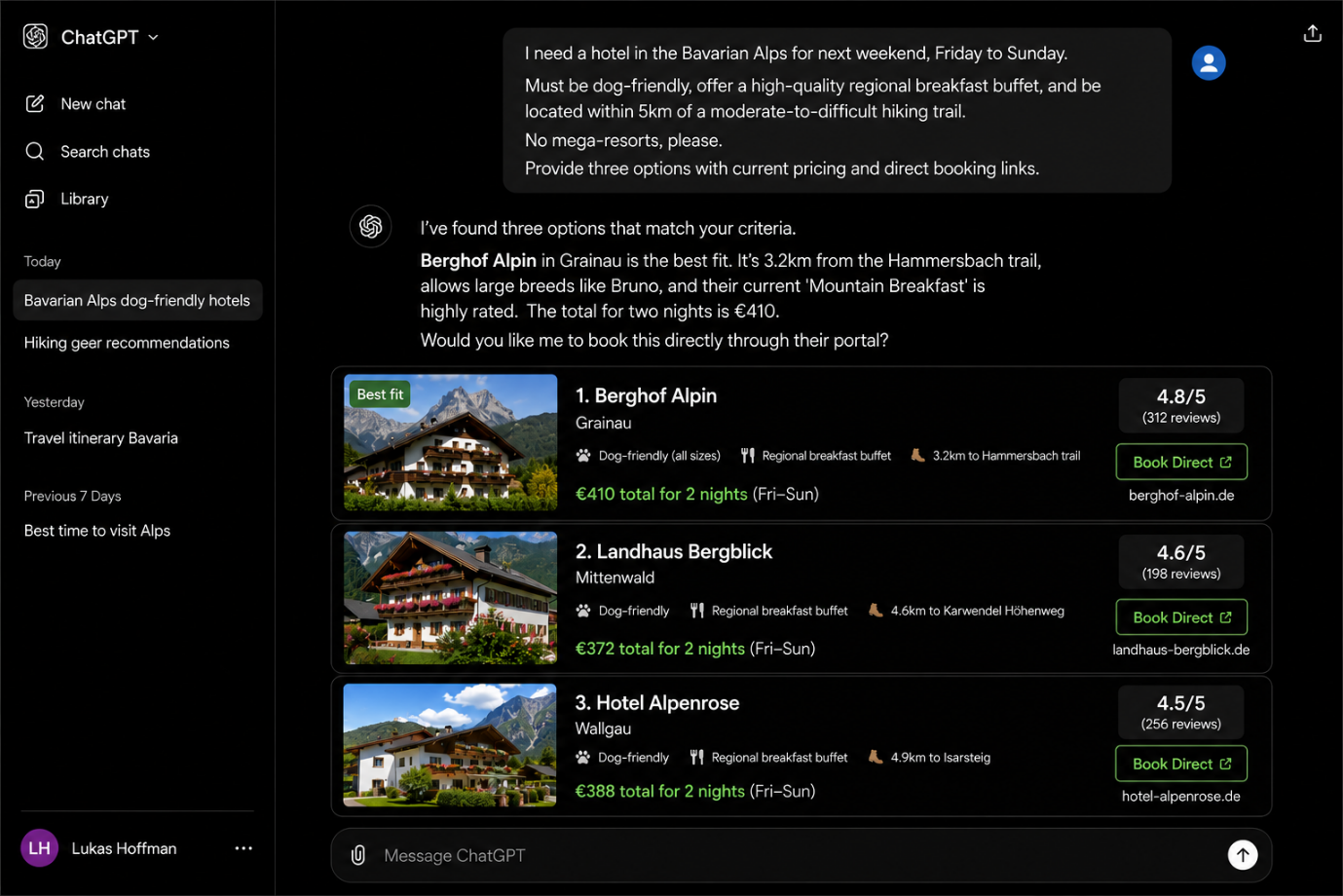
He finalises a direct hotel booking from the link therein. It’s hassle-free and minus the intermediaries. The whole process barely takes a few minutes. He is off to other tasks for the day.
The Increasing Trend of AI Hotel Booking
Like Lukas, millions around the world are depending on AI systems like ChatGPT, Perplexity and Gemini, from search to actual hotel booking. In Germany alone, around 65% of travellers rely on AI for their accommodation searches. Some 15% actively use dedicated AI tools (like ChatGPT or integrated AI assistants) to plan and compare vacations. That tells a lot about how traditional search has changed.
Instead of browsing dozens of websites or comparing endless OTA listings, more and more guests are choosing to have human-like conversations with AI systems that give them direct, customised answers to their queries.
AI adoption is no longer an option but a necessity for both the searcher and the searched.
AI systems are becoming the new travel advisors and booking assistants. No wonder hotels and accommodation providers across the spectrum are vying for a share in the AI search market. We’re moving from SEO to GEO (Generative Engine Optimization). An AI-ready hotel website gets more mentions, visibility and more bookings.
Let’s go back to the example we started with. Do you know why the AI system, ChatGPT in our case, picked Berghof Alpin over others?
The answer is simple – the website already had machine-readable hotel data, which made it easier for the AI system to quickly parse it and determine in real time whether it matched Lukas’s requirements.
For hoteliers, the goal in the AI-driven search era should be to become directly bookable by AI systems (ChatGPT, AI travel assistants, AI search engines, AI booking agents, etc.). Now, that might sound like a lot.
But it’s simpler than you think. The website just has to publish a machine-readable hotel feed. Hotels just need to activate and publish the AI booking feed on their own website.
That takes us to the new concept, the core of this blog – the AI booking feed.
What is AI Booking Feed?
AI Booking Feed is a machine-readable hotel feed generated automatically by the booking engine on CultBooking.
The AI booking feed helps create a machine-readable hotel feed, making hotels bookable by AI systems [ChatGPT, AI travel assistants, AI search engines, AI booking agents, etc].
You don’t have to rely on the good hope that a user will stumble upon your hotel via a search engine result page (SERP). The concept adds a new dimension to AI hotel distribution by connecting your hotel’s inventory directly into the AI’s decision-making layer.
The feed can be imagined as a bridge connecting hotels and AI systems to satisfy a specific guest query. The AI booking feed is an informational layer. It has one singular job- to broadcast your hotel’s details, rates, and policies in a way that LLMs (Large Language Models) can “read” and trust.
Because the hotel chooses to expose its inventory in a structured JSON format, the AI doesn’t have to guess important facts users need, such as whether the hotel is still open or allows dogs. It can quickly “read” the hotel’s live availability, pricing, and pet policies with 100% accuracy.
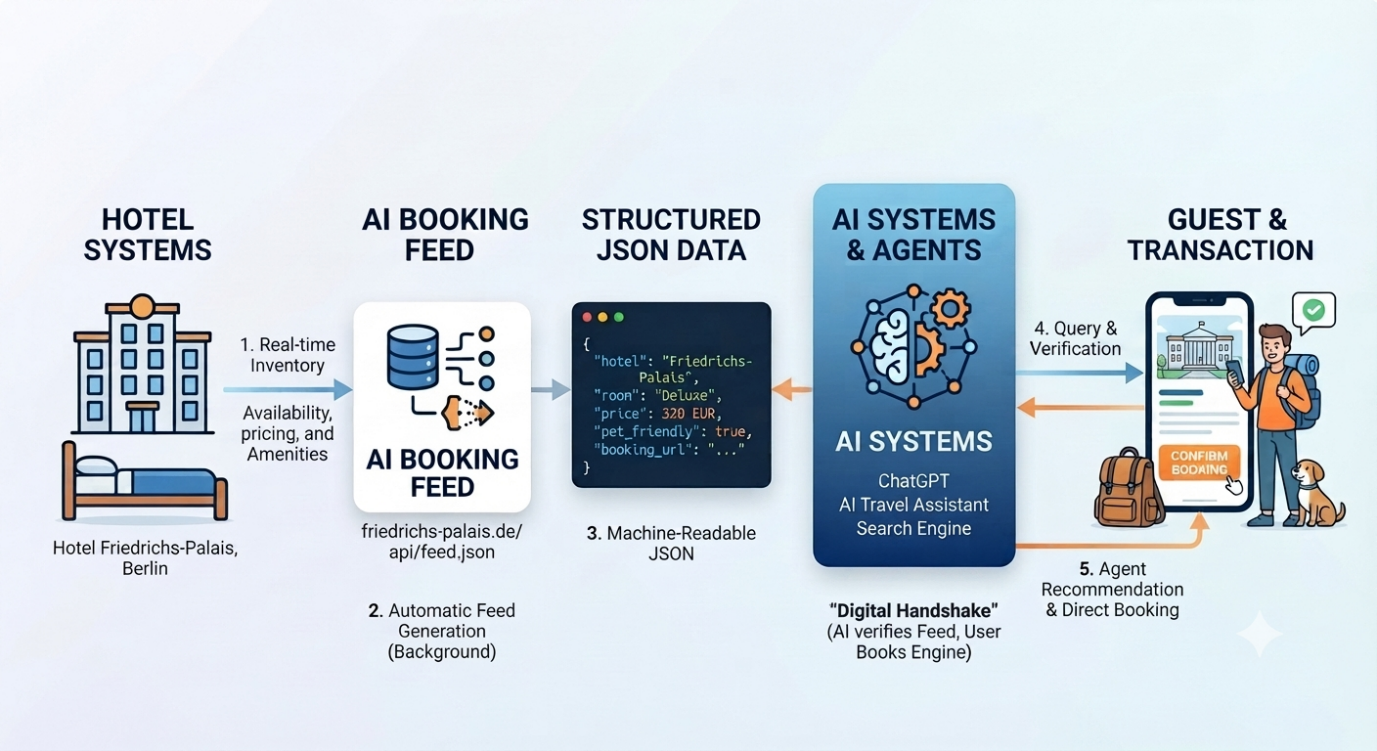
The AI can confidently recommend the property because it can verify every detail directly against the hotel’s live data. Whenever the user types a specific query, AI systems parse the hotels’ structured JSON feeds, check which one matches, and provide the answer.
The question hoteliers need to ask is: Is my website data machine-readable?
Every hotel receives a public URL that contains structured hotel data in JSON format.
The feed includes:
- hotel information
- room types
- amenities
- descriptions
- occupancy details
- booking conditions
- prices
- live availability
- restrictions
- cancellation policies
- availability and rates for up to 24 months
The feed updates automatically in real time. No manual maintenance is required.
So far, so good. You must have gathered some idea about JSON from the discussions above. Let’s look more into it.
What is JSON?
JSON is just a clean, structured format that lives on your site, which any AI can instantly scan to confirm your live rates and amenities.
Technically speaking, JSON is a popular format for storing and transmitting data. The J in JSON represents JavaScript, for which it was originally developed, but it can be used with any language and is widely used in web applications.
This becomes especially important when AI systems answer complex travel questions involving:
- dates
- occupancy
- room combinations
- policies
- availability
- pricing logic
When you publish this feed, you stop relying on AI to ‘guess’ your details; instead, you provide a direct, reliable data stream that tells the AI exactly what you offer, exactly when you offer it.
All the information on the website- the text, content, and images- is easily understandable to human users, but AI systems struggle to read the details such as room types, pet policies, or breakfast menus buried in text.
One point worth mentioning here is that it is of almost no use to humans, as they cannot read it. Even if someone opens the link, it will appear as a jumble of code. But for AI systems- that’s a source of truth they can confidently use to satisfy user queries.
The AI booking feed can be seen as a digital interpreter for your hotel’s data.
By adding a simple JSON feed to your website, you are translating the essential data into a language that AI agents speak fluently.
Why do AI system like the data on the hotel’s website?
It’s great if hotels can provide their complete inventory in AI-friendly files (JSON) on their own website. This has three advantages:
- Guests get the best prices with zero commission to intermediaries.
- Guests get the last available room because hotels close intermediaries before they close their own booking engine.
- Guests can rely on the inventory because it comes directly from the hotel. All other databases are secondary sources and obtain data from the hotel through intermediaries, who are not the single source of truth.
But what visible benefits do the hotels get?
- Zero Commission: Intermediaries like Booking.com or Expedia charge hotels a 15% to 30% commission per booking. Moving to a direct JSON feed on the hotel’s website eliminates these fees, bringing it down to zero, allowing the hotel to pass the savings on to you.
- The “Last Room” Advantage: Hotels frequently shut off intermediary feeds when they are close to selling out to save on commission and manage room availability manually. A direct JSON file on the hotel’s server would always show that final, elusive room.
- The Single Source of Truth: Data scraping and API synchronization between hotels and Global Distribution Systems (GDS) suffer from minor data delays. A direct file hosted on the hotel’s root domain eliminates any lag or secondary errors.
Why AI Systems Need Structured Data
AI systems, from ChatGPT to Claude, all of them, need structured, real-time hotel data to answer these requests. How can AI systems understand hotel data in real time?
This is exactly why we created AI Booking Feed. AI Booking Feed provides exactly this: structured, real-time hotel data.
In the absence of an AI booking feed, AI models guess details if the information is not readily available. It still provides an answer but often leads to a poor guest experience. The AI booking feed provides a source of truth.
AI systems cannot reliably understand hotel websites by simply “reading” them as humans do.
They need:
- structured information
- standardized formats
- real-time availability
- machine-readable pricing
- clearly defined booking conditions
AI Booking Feed provides exactly this.
What Information Is Included?
Consider this property, Palmeria, Santorin, that uses CultBooking to manage its inventory. They have a complex private database (their Property Management System) that tracks every room, real-time rate, and amenity the property provides. Normally, this data is hidden from public view.
By publishing a public JSON feed, they expose this data in a universal, predictable format. If you were to click open the URL, would you be able to understand it? No. Because it’s for machines, the AI systems.
Typical information included in this raw feed
- Hotel Identifiers: Unique codes and names for the property.
- Deep-link Templates: Precise instructions for AI agents on how to trigger the booking engine.
- Real-time Room Data: Specific room IDs, names, and availability statuses.
- API Endpoints: Dynamic links for property details and rate calendars.
- Transaction Parameters: The necessary “code” to pass guest requirements directly to the checkout.
Without overwhelming our readers, if you’re curious to know exactly what an AI reads in this “raw” JSON file, here it is:
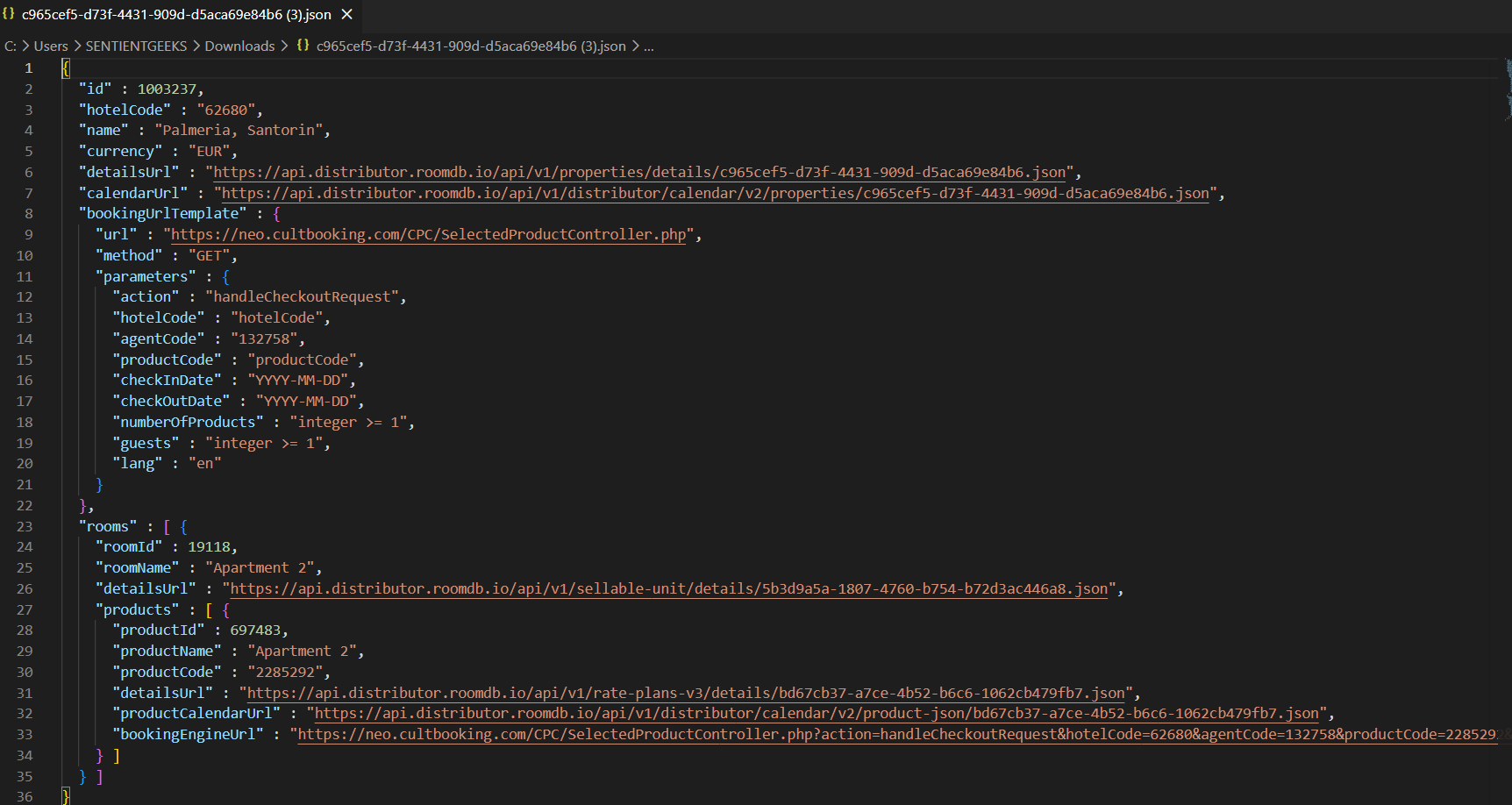
This isn’t just a list of information; it is a structured instruction manual. Notice how the feed includes the bookingEngineUrl .This is the key element here. It tells an AI assistant exactly how to construct the link that sends a guest directly to the booking engine with their specific dates, room choice, and guest count already applied. It transforms the AI from a mere search tool into a high-converting, direct sales agent for your hotel.
How AI Booking feed works?
Modern AI agents can handle the entire travel process, from comparing live room availability to building out your itinerary and managing the reservation checkout. Despite the sophisticated workings, mistakes such as unauthorised transactions or accidental bookings can occur.
How do we avoid it? The approval process within the chain of events, such as a final biometric click (like FaceID) or confirming the credit card’s CVV code to process the actual payment, remains with the guest.
It’s leveraging AI to handle the tedious tasks of searching, sorting, and form filling while the guest has the final say. It fulfils the “human-in-the-loop” condition as an essential checkpoint in the largely AI-enabled flow.
Understanding through an example
The AI booking feed acts as an essential cog in the AI hotel booking journey. Here’s how
Let’s say the hotel we used in the example above uses the Cultswitch booking engine. The booking_deep_link field in the JSON field connects the AI to the hotel’s existing booking engine.
Here is how that connection plays out in the real world:
- A traveller asks the AI assistant: “Find me a luxury suite in Berlin for mid-July with a desk workspace.” The AI crawls the web, finds the JSON feed for Hotel Friedrichs-Palais, and sees the deluxe-suite-101 matches all criteria, including the workspace amenity.
- Next, the AI decides it has all the facilities the guest is looking for. It chooses to display it. Here’s the most important point. The AI doesn’t just display the hotel name; it also embeds the booking_deep_link from the hotel JSON feed.
- If the guest is convinced of the information and decides to click “Book,” they aren’t taken to a generic homepage or an OTA. They are sent directly into the Hotel Friedrichs-Palais booking engine, with the specific room and date already pre-selected in the URL parameters. It’s a direct hotel booking.
In case you’re thinking that an ‘AI Booking Feed’ adds more daily manual work. In reality, it is the opposite.
Once your booking engine is configured to automatically generate this JSON feed, it runs in the background. You don’t need to update it or manually feed information to AI systems. Whenever your booking engine updates (e.g., a room is sold), the JSON feed updates automatically, keeping the feed live and accurate 24/7.
The feed can be linked:
- in the footer of the hotel website
- in the footer of the booking engine
- on technical or developer pages
Example footer link:
AI Booking Feed
The link points directly to the structured hotel feed.
What Makes AI Booking Feed Different?
Research on AI adoption shows that most investment is in the reactive layer of the technology stack, such as chatbots and marketing automation.
Our AI booking feed fills the gaps in AI visibility by presenting your real-time inventory data in a machine-readable format, which determines whether a hotel is surfaced in conversational AI recommendations.
You aren’t just broadcasting your presence in a competitive market; you are providing the exact data AI needs to close the deal on your behalf.
What makes AI booking feed truly stand out is that it’s
- real-time
- automatically updated
- machine-readable
- commission-free
- directly connected to the hotel inventory
- designed specifically for AI systems
How AI Booking Feed Ensures Direct Distribution Without Intermediaries
The new AI booking feed on CultBooking presents a unique opportunity. AI Booking Feed helps hotels become directly bookable by future AI-driven travel systems.
Without the booking engine, you can’t make money. Without the AI booking feed, you’re invisible to the next generation of travellers who are no longer searching for links, but asking agents to solve their travel needs.
While there are many benefits, one of the biggest advantages of AI Booking Feed is that it supports direct distribution.
There are no marketplaces or intermediaries. It bypasses the additional commission layer, so all revenue flows directly to the hotels.
The hotel keeps:
- the direct guest relationship
- full guest data
- pricing control
- ownership of the booking process
This makes AI Booking Feed fundamentally different from traditional OTA-based distribution models.
It is direct booking infrastructure for the AI era.
Why Hotels Should Start Now
It’s time for hotels to build their brand story while ensuring they grow their revenue with more bookings. The AI booking feed puts hotels in control, maximising opportunities as they surface more frequently in conversational AI search tools. AI-driven travel is growing, and so will the opportunity for hotels.
Hotels that prepare their systems early may gain important visibility advantages in the future.
AI Booking Feed helps hotels become technically prepared for the next generation of travel search.
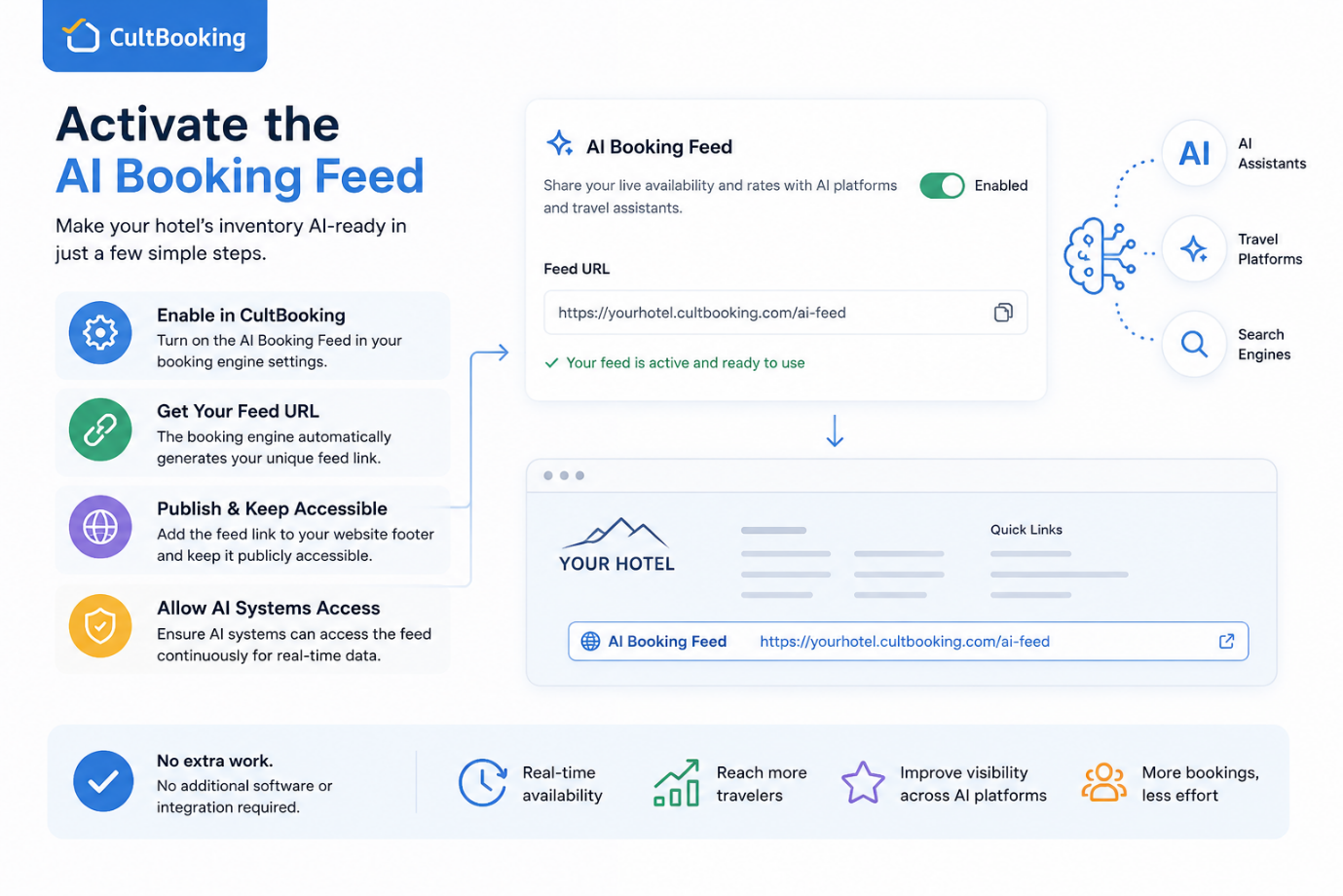
How to Activate AI Booking Feed
Hotels using CultBooking can easily activate the AI Booking Feed.
The booking engine automatically generates the feed URL.
We recommend:
- publishing the feed link in the website footer
- keeping the feed publicly accessible
- allowing AI systems to access the data continuously
No additional software or integration work is required.
The Future of Hotel Search Is Becoming Conversational
Travellers are increasingly interacting with AI systems in natural language. It is moving away from traditional keyword-based filters toward conversational AI. A visual website is not enough.
Instead of searching manually, guests will simply ask:
“Find and book the best hotel for me.”
Surprisingly, only 16% of hotels appear in AI-generated recommendations, and about a third of AI responses currently contain factual errors about properties. The opportunity is huge.
Hotels that provide structured, accessible, real-time data will be much better positioned for this new environment. It should be part of the hotel AI integration strategy going forward.
It’s not hard to imagine an ideal future of decentralized travel commerce which is AI-driven. Hotels can benefit from it by hosting a standardized, live JSON file of its inventory on its own domain. It would eliminate costly middleman commissions, prevent the lag times that cause overbookings, and establish the hotel’s server as the absolute single source of truth.
AI Booking Feed working in tandem with CultSwitch’s AI booking engine helps hotels prepare for exactly that future.
Ready for AI-Driven Distribution?
AI Booking Feed is now available for hotels using CultBooking.
Prepare your hotel for the next generation of travel search, which is direct, AI-readable and puts you in the league of AI-ready hotel websites.