

 info@cultbooking.com
  0049 30 726225 0
Published on: 02 Sep 2026
What makes a digital product or tool truly great? It’s accessible to everyone. Digital accessibility, or web accessibility, means designing digital tools, platforms, and products that everyone, including people with disabilities, can easily use.
That immediately brings into focus some 1.3 billion people (16% of the world’s population) who live with some kind of disability.
Accessibility is more than just a nice- to-have label
In 2019, pizza giant Domino faced a serious challenge. A blind customer, Guillermo Robles, sued the pizza chain. His frustration mounted after failing to place an order through Domino’s website and mobile app using screen-reading software. The case went all the way up to the U.S. Supreme Court.
It became one of the most-cited legal precedents for digital accessibility in the U.S. He put forth a very strong argument citing anomalies in the Americans with Disabilities Act (ADA). He argued that if the ADA applies to physical stores, it should also apply to the business’s digital footprint — its website and app.
It not only dented Domino’s reputation but also forced many businesses to take web/app accessibility (WCAG compliance) seriously rather than just a nice-to-have label. Soon, many realized that having a digital asset that didn’t meet all the accessibility requirements could cause both legal and reputational damage.
What is digital accessibility?
Digital accessibility is built around a core objective: making online spaces fair, open, and usable for everyone. In practice, it means designing digital tools and platforms, including websites, apps, and booking systems, so they work equally well for users with visual, auditory, motor, and cognitive disabilities.
Disability should not be a barrier to service. This is guided by the Web Content Accessibility Guidelines (WCAG), the internationally recognized standard that defines what “accessible” actually means in measurable, testable terms. It lists the criteria, from screen reader compatibility to keyboard navigation to color contrast, that systems must meet.
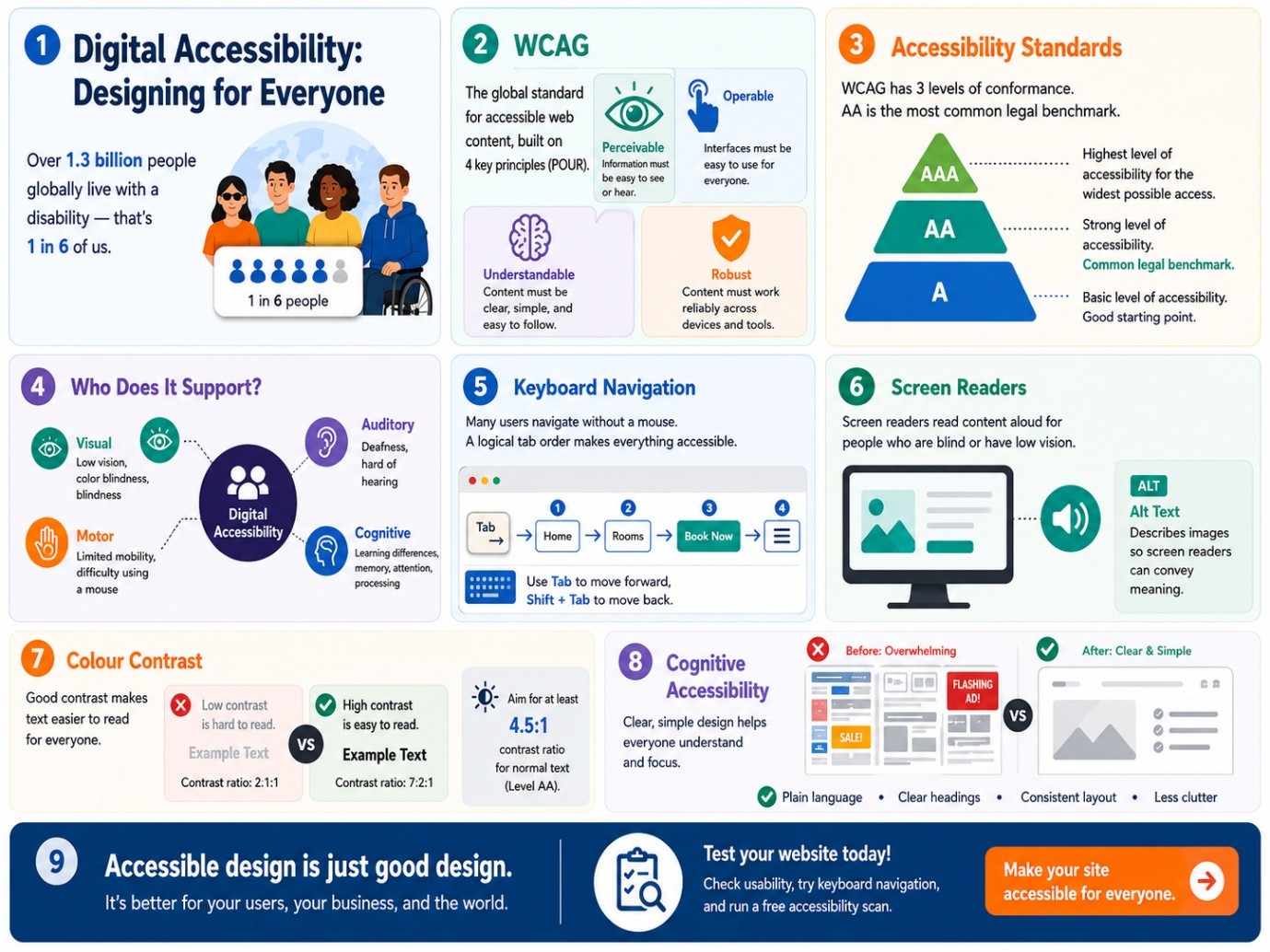
The World Health Organization estimates that 1.3 billion people, roughly 1 in every 6 people globally, live with some form of disability. Yet many of them still face significant barriers when planning travel, particularly during online interactions like searching, comparing, and booking.
A travel platform that invests in genuine accessibility and adheres to WCAG standards is well positioned. It’s removing friction for a massive, currently under-served market, and positioning itself to capture demand that inaccessible competitors are quietly losing.
Inclusion leads to conversion
For service providers, accessibility and inclusion are two sides of the same coin. Today, in 2026, as billions rely on online interactions for daily tasks, shopping, and travel bookings, accessibility is a must-have, not a mere compliance checkbox. Take the case of an accessible reservation system versus one that doesn’t have it.
If a guest cannot complete the booking because the widget isn’t usable, they’ll book elsewhere. There’s a huge opportunity for businesses that create more accessible digital pathways for these users, who are high spenders and loyal customers.
A study by Accenture, conducted over more than 4 years and including 100+ companies, suggests that businesses that care about inclusion and accessibility registered 28% higher revenue.
Studies reveal that there’s $13 trillion in market opportunity for businesses that can improve their products and services to enhance accessibility and disability inclusion.
Travel and accessibility – The new imperative
Major demographies of the world, including Europe, are aging, which means more people with disabilities. In Germany, out of every 5 citizens, one is aged over 66. Also, every second citizen is older than 45. With the oldest and fastest-aging populations in Europe, travel accessibility is a prime driver.
To meet the needs, we have Reisen für Alle (or “Travel for All”) in place. As a nationwide, standardized certification and labeling system, it further advances the cause of barrier-free and accessible tourism.
Hoteliers are waking up to the fact that accessibility starts from the moment a traveler steps onto the property or parks a vehicle, and continues through navigating public areas, elevators, and room interiors. And it goes beyond.
Whether it’s the choice of an accessible hotel reservation software or a booking engine, accessibility in hotel technology is now a key business differentiator.
Why hotels should care about accessibility
Before any discussion, it’s important to dismantle the wrong notion that people with disabilities either do not travel or travel less. Latest research from MMGY Travel Intelligence, ENAT, and the WTTC confirms that nearly 50% of European travelers with accessibility requirements take at least one leisure trip abroad.
Data show that some 20% of travelers have specific accessibility requirements and usually opt for premium booking options. A fully accessible ecosystem from digital booking engines to physical properties ensures these customers stay with them.
These guests with specialized requirements are looking beyond accessible website content and seeking accessible booking journeys. Older travelers are frequent, high-spending guests.
The accessibility information on the website helps these customers in pre-travel booking. Courts and regulators, as regulations tighten worldwide, increasingly view a broken booking flow as a major accessibility flaw that can attract severe penalties.
Despite their huge population, the value they bring is largely invisible. They face significant barriers across the five major markets studied, including Germany. And our research shows these can be easily avoided only if we have accessible systems in place.
Benefits of putting accessibility as a core feature for hotels
- Broader customer reach – It’s a high-value but underserved market. Disabled travelers in Germany spend ~16% more per trip than non-disabled travelers. Also, studies show that elderly travelers, in general, have higher disposable income and average travel spending than the younger demographic.
- Better user experience – Most users look for friction-less experiences during booking trips. Imagine a guest booking for a group, family, or partner finding that the hotel’s booking engine or listing page fails to answer accessibility questions clearly. Hotels risk losing business to the nearest competitor.
- Improved conversion – With critical friction points eliminated in the user’s journey, an accessible booking engine will automatically boost direct conversion rates, reduce card abandonment, and build a loyal customer list.
The target segment is looking beyond content they can read. A hotel platform that doesn’t have a keyboard-navigable UI, WCAG-compliant color contrast, and screen-reader-friendly date pickers is making an expensive misjudgment.
- Enhanced brand trust – An accessible hotel is a direct indicator of the business’s commitment to inclusivity. If brands secure the right first impressions when customers interact with the website or booking engine, with screen-reader-friendly pages and WCAG compliance built in, they are already ahead of their competitors.
If your booking engine conveys that you care, guests are more likely to believe they are signing up for an enjoyable travel experience.
- Legal and compliance safeguard– The regulatory risk is very real. Surprisingly, most WCAG fixes do not require costly investments or intensive development hours. Accessibility legislation is becoming stricter worldwide.
Hotels with inaccessible systems, such as a booking engine that fails to meet accessibility requirements, are a liability. It does more damage than just the loss of customers. It’s a legal problem.
The Americans with Disabilities Act (ADA) explicitly requires that a hotel’s reservation system be usable by people with disabilities. Most laws draw on the Web Content Accessibility Guidelines (WCAG) 2.1 or 2.2 at Level AA.
In Germany, digital accessibility laws derive from the Accessibility Strengthening Act (Barrierefreiheitsstärkungsgesetz, or BFSG), which came into full effect on June 28, 2025, and can draw fines up to €100,000.
An accessible booking engine is a business advantage
This is a classic case of how it’s not just enough to have a great-looking website; you also need a robust, accessible booking experience to get more business.
Marcus is a senior corporate executive and high-net-worth individual (HNI) based in Frankfurt. He’s visually impaired too. He loves traveling and is planning a luxury weekend getaway to Berlin. He relies on a screen reader and keyboard-only navigation.
The booking engine features a date picker and room-selection drop-down menu that completely lack proper ARIA labels and logical keyboard focus management. When Marcus attempts to tab through the dates using his keyboard, he is stuck. The focus trap locks up, and his screen reader outputs unformatted code blocks instead of communicating available rates or specific room accessibility parameters.
He cannot check out. Frustrated, he abandons and books a suite on some other platform. The luxury property loses a high-value, high-spending guest who was only seeking a simpler accessible booking experience.
What needs to be understood here is that optimizing the homepage design, imagery, and menu navigation is necessary and constitutes touchpoints along the user journey. Still, the entire guest journey ultimately converges inside the booking engine. If the reservation software itself presents barriers to interaction, it leaves room for more improvements.
CultBooking, the booking engine used by hotel businesses and property owners, confidently bridges the gap, as will be seen later.
CultBooking’s commitment to accessibility
CultBooking is at the heart of many hotels’ operations today. It is a high-performance booking engine that enables easy, hassle-free booking directly from the hotel’s website. It is used by apartments, hotels, guesthouses, B&Bs, villas, hostels, and other accommodation providers, and is highly responsive as a channel manager across desktop, tablet, and mobile devices. But there’s more to it.
We took accessibility seriously and ensured that, no matter who uses our booking engine, more guests can complete bookings independently.
The CultBooking engine has been independently assessed for accessibility. The Accessibility Conformance Report (ACR) findings convincingly prove that accessibility has been engineered into the booking experience itself, not as an afterthought but as a primary requirement.
CultBooking’s booking engine has been independently evaluated against WCAG 2.2 Level AA and Section 508. This is the current industry standard. The full report has been documented in a formal Accessibility Conformance Report and actively maintained. The evaluation is very recent, conducted in July 2026.
The report is available upon request for hoteliers who need documentation as part of their compliance or procurement processes.
What does CultBooking’s Accessibility Conformance Report (ACR) mean
Accessibility remains an ongoing area of work.
The ACR report covers perceivability, keyboard operability, and consistent navigation, with most applicable success criteria supported. It evaluates the booking workflow itself. We list down what areas were independently examined and it’s broader implication for our clients.
| Assessment Area | What it means | Why it matters to Hotels |
|---|---|---|
| W3C WCAG-EM Methodology | The booking engine was evaluated using the internationally recognised W3C accessibility evaluation framework. | Provides confidence that accessibility was assessed using an industry-standard process. |
| Manual Testing | Accessibility experts manually reviewed user journeys and interface elements. | Helps identify real-world usability issues that automated tools may miss. |
| Automated Testing | Software tools scanned the booking engine for accessibility issues. | Ensures broad coverage and helps detect common accessibility problems efficiently. |
| Assistive Technology Testing | The booking engine was tested using technologies that people with disabilities rely on. | Demonstrates that real users can interact with the booking engine effectively. |
| JAWS Screen Reader | Tested compatibility with one of the world’s most widely used screen readers. | Helps blind and visually impaired guests complete bookings independently. |
| NVDA Screen Reader | Verified accessibility using the popular free screen reader for Windows. | Ensures compatibility across different assistive technology users. |
| VoiceOver | Tested with Apple’s built-in screen reader. | Supports guests using macOS and iOS devices. |
| Chrome, Firefox & Safari | Accessibility was verified across major web browsers. | Provides a consistent booking experience regardless of the browser guests use. |
There’s hidden business value for our clients who use the CultBooking engine. Fundamentally, it means the following benefits for guests.
- Guests who have difficulty using a mouse can still complete reservations.
- Blind and visually impaired travelers can book accommodation independently.
- Fewer abandoned bookings because forms are usable by assistive technologie
Accessibility features that benefit hotel guests
Our clients can confidently claim their booking process has been independently assessed for accessibility. This immediately position them as inclusive, empathetic and a brand cut above the rest.
| Accessibility Feature | Benefit for Guests |
|---|---|
| Keyboard-only Navigation | Guests can complete bookings without using a mouse, making the booking process accessible to users with motor impairments. |
| Screen Reader Support | Blind and visually impaired guests can navigate and book using screen-reading software. |
| Focus Management | Keyboard users can clearly see where they are on the page while navigating forms and booking steps. |
| Logical Reading Order | Information is presented in a meaningful sequence, improving usability for assistive technologies. |
| Meaningful Labels | Form fields and controls are clearly described, making them easier to understand and complete. |
| Error Identification | Validation errors are clearly communicated, helping users correct mistakes without frustration. |
| Consistent Navigation | Menus and navigation behave predictably throughout the booking journey, reducing confusion. |
| Accessible Forms | Booking forms are designed to be usable by a wide range of users, including those relying on assistive technologies. |
| Text Resizing | Guests can enlarge text without losing content or functionality. |
| Responsive Layouts | The booking engine remains accessible and usable across desktops, tablets, and mobile devices. |
How WCAG compliant CultBooking engine offers competitive edge for hotels
It’s time to view compliance as a peripheral, once-a-year checklist item. It is a market differentiator with the potential to drive more revenue for forward-thinking businesses. It’s important to showcase how our compliant booking engine brings multiple benefits to our clients.
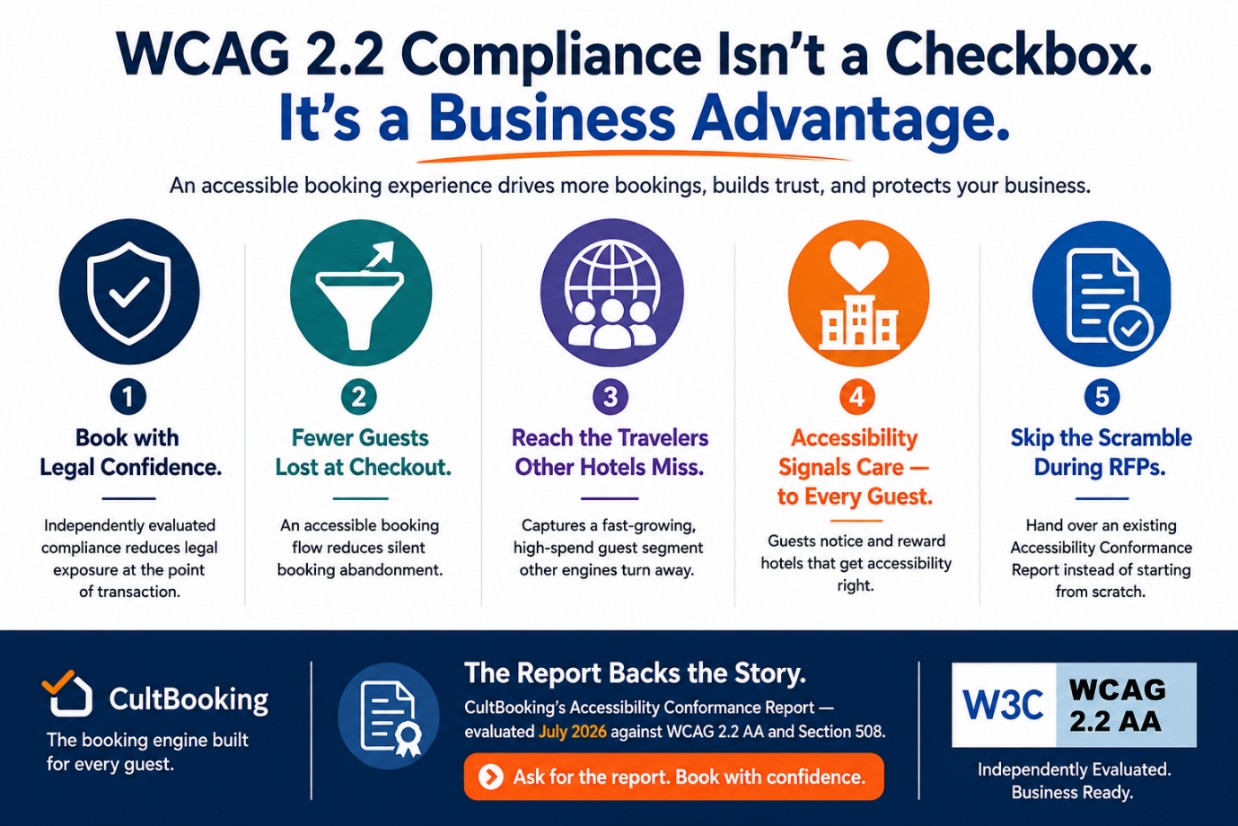
- Tap into an underserved market – Research repeatedly shows that this segment is underserved but holds high revenue potential. The community spends more per trip than non-disabled travelers.
A booking engine that meets screen reader and keyboard navigation accessibility requirements positions hotels to capture bookings profitably.
- Offset’s legal risk- The hundreds of properties that currently use our booking engine must know that, as they are using a WCAG 2.2 AA / Section 508-compliant engine, this reduces their liability and safeguards them against non-compliance risks.
As we’re past the European Accessibility Act’s compliance deadline, it’s a legal requirement for hotels operating in the EU. Hotels using CultBooking can point to third-party evidence of conformance and may not need to prove it directly themselves.
During vendor or partner selection, as in cases like corporate bookings or government tie-ups, these hotels can also put forward our report instead of commissioning their own compliance audit when they are asked to show if they have documentation (VPAT/ACR)
- Refined brand and guest experience – In 2025, WebAIM analyzed one million homepages and found that 94.8% had WCAG failures. The case is also true for platforms in the hotel industry.
Most competing hotels and OTAs haven’t yet independently tested their booking flow. Being able to say “our booking engine is evaluated against WCAG 2.2 AA” is a concrete claim a hotel’s marketing or PR team can use to good advantage.
Loyal, high-spending customers will not bring repeat business, but hotels also gain from word-of-mouth publicity.
Looking forward
Accessibility has to move beyond the compliance compulsion if it is to serve more people who deserve an enriching travel experience, irrespective of their physical limitations. It’s about enabling every guest to complete a booking independently.
Hotels do better when they are confident that the most critical customer journey on their platform is secure and verified. Our WCAG 2.2-compliant CultBooking engine does just that. Step into the future of travel where everyone’s included.